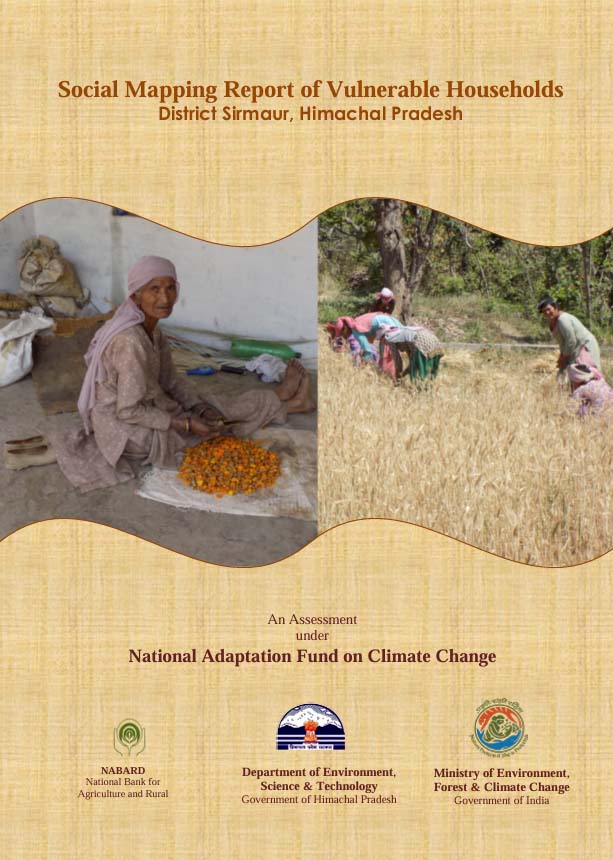

Under the NAFCC project, a community-based vulnerability analysis was carried out, adopting a framework different from conventional planning approaches. The analysis was premised on the three dimensions of exposure, sensitivity, and adaptive capacity to capture climate-induced risks in agriculture and water resources. This approach emphasized localized, participatory inputs in order to strengthen climate resilience at the grassroots level. The vulnerability analysis encompassed the following major tasks:
Assessment of Climate Hazard Scenarios
Climate change hazard scenarios were analyzed for short-term, medium-term, and long-term horizons. The assessment relied on historical data of major hazard events (droughts, floods, unseasonal rainfall, landslides, hailstorms) specific to the project region, with particular focus on agriculture productivity, horticultural systems, and water availability. This exercise helped establish the trend and intensity of recurring climate stresses.
A robust ESA database was prepared at the block level and extended to the micro-watershed and Panchayat/village resolution. This granular dataset provided insights into:
Exposure to agro-climatic shocks (rainfall variability, temperature rise, extreme events).
Sensitivity of local communities in terms of crop choices, irrigation practices, soil quality, and livelihood dependencies.
Adaptive capacity indicators, including institutional support, local knowledge systems, infrastructure access, and diversification of livelihoods.
Unlike conventional planning, this multi-resolutional approach enabled bottom-up integration of community needs into adaptation planning.
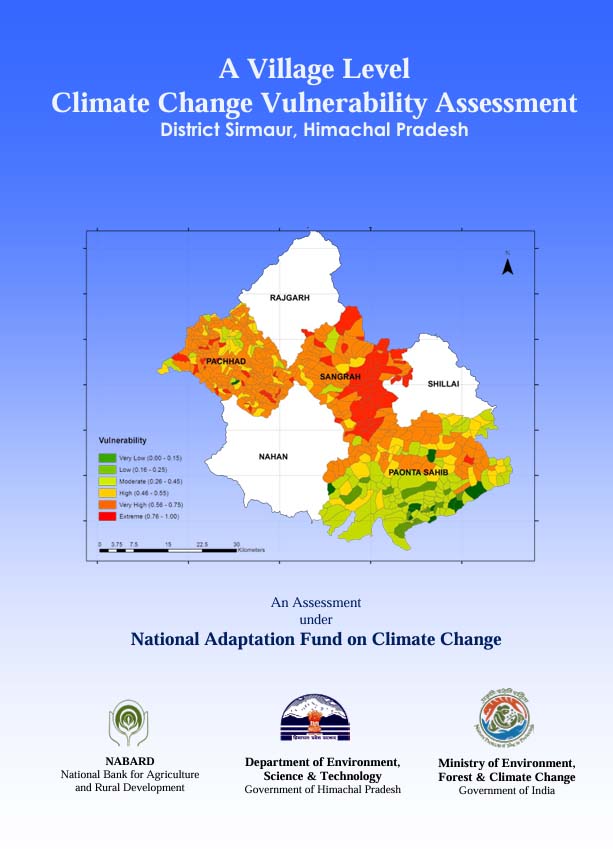
Comprehensive Vulnerability Assessment
The project undertook a multi-dimensional vulnerability analysis, covering, physical vulnerability (soil erosion, irrigation infrastructure, water scarcity), Economic vulnerability (income dependence on climate-sensitive crops, market fluctuations, productivity risks), Social vulnerability (marginalized groups, women farmers, landless households with limited resource buffer), Environmental vulnerability (forest degradation, pressure on water resources, biodiversity loss), Climate change vulnerability (projected regional warming, rainfall extremes, glacial melt impacts).
Risk Assessment of Agriculture and Water Sectors
A sector-specific risk analysis identified the degree of threat faced by agricultural production systems and water security. This included mapping risk-prone crops, damage trends from drought/flood, irrigation facility stress, and potential cascading impacts on food security and rural economy.
Community and Institutional Capacity Assessment
Capacity assessment was conducted at village, Panchayat, block, and district levels to evaluate institutional readiness and identify associated vulnerabilities for agriculture, horticulture, and water security. The exercise examined gaps in technical knowledge, disaster preparedness, resource mobilization, and policy support. Outcomes highlighted priority areas for capacity development interventions, including climate-resilient farming techniques, diversified cropping patterns, water conservation methods, and strengthened local governance mechanisms.